 Library
FreedomRPG vs Everweave: which solo D&D app should you play?
Updated 2026-07-03
Some of FreedomRPG's most engaged players came from Everweave, and the first creators who covered FreedomRPG came from Everweave's audience. They keep telling me the same story: the first evening is magical, and then the world starts slipping. I built FreedomRPG around exactly that problem, so a comparison between the two is really a comparison between two different bets on what matters in a solo RPG.
FreedomRPG and Everweave are both AI game masters for solo D&D-style play, and they've invested in opposite halves of the experience. Everweave looks like a video game: painted art on every screen, a proper character-creation wizard, an equipment paper-doll, music, seasonal events, and native apps on both stores. FreedomRPG plays like one that remembers: your world's characters, places, rules, and lore are kept as real, tracked things the game master maintains, on Claude, with real dice and voice narration. If you want a D&D-looking game on your phone tonight, Everweave is better at that. If you want one world that's still consistent in session forty, that's what FreedomRPG is built for.
If you play Everweave past the honeymoon, you know the wall. The DM forgets what's in your bag, your companion stops acting in fights, a character you've traveled with gets misremembered. None of that means the app is badly made. It means the story lives inside a model's short memory, with nothing underneath keeping the world true.
How each one remembers your world
Everweave's structured state is the character: an equipment sheet with computed armor class, ability modifiers, hit dice, spells. It's genuinely nice. But the world outside your sheet (the town you saved, the merchant you robbed, the cave you half-explored) lives in the DM's prose memory, and players consistently report it fading after a few hundred messages, with inventory and companions the first things to go.
FreedomRPG keeps the world itself. Anything worth tracking lives as a structured entity the game master reads and updates while you play, and the system doing the tracking isn't fixed: the GM builds the rules of your world in real time. Walk back into a town after fifty hours away and the GM isn't reconstructing it from prose, it looks the town up. Context runs around 300k tokens with automatic compaction, and the GM's memory carries across your games, not just within one. Characters get the same treatment: each one keeps a private inner monologue, persisted on the character, so an NPC thinks their own thoughts during a scene and still remembers them when you cross paths a week later.
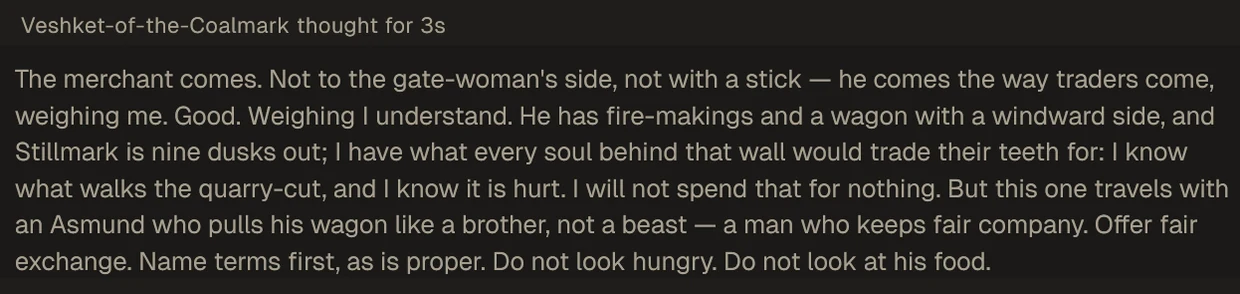
An NPC's private thoughts from a real game. The player only sees this if they choose to peek; the character remembers it either way.
The correction experience is where the difference bites hardest. In both apps the GM will sometimes get something wrong, and in both, correcting it costs you something. The difference is whether it works. In FreedomRPG you step out of character, say what's wrong, and the GM fixes it, remembers the correction, and carries the lesson into your future games. Everweave's players describe corrections being read as story tension, with the DM digging in instead of fixing the mistake.
The model doing the storytelling
Everweave has never said what model runs its DM. Whatever it is, response speed is sold as a paid feature: free players wait, higher tiers go faster, and the top tier costs $54.99 a month.
FreedomRPG runs Claude for every player, on every tier, up to Claude Fable 5 (Anthropic's newest model) on the top one. Prose quality, holding your world's rules, and playing a scene straight instead of drifting into cliche are exactly what frontier models are better at, and in a game held together by the model's judgment, you feel it within a session or two. One day open models will be good enough for this, and when that happens FreedomRPG will run them too. Today the gap is real.
Rules, dice, and what's actually enforced
Everweave is explicitly 5e-shaped: point-buy stats, SRD classes and races, new classes arriving as content updates. The shape is real, but the enforcement belongs to the model. Its own community documents armor class drifting between attacks and action economy dissolving mid-fight, because there's no engine underneath doing the math.
Both apps roll real dice, in very similar ways: standard TTRPG notation against difficulty checks, shown to you. The difference is what happens after the roll. Whether a game master actually abides by the dice and the stats comes down to the model running it, and that is where the two diverge: FreedomRPG's frontier-model GM holds the numbers, where Everweave's players document the drift.
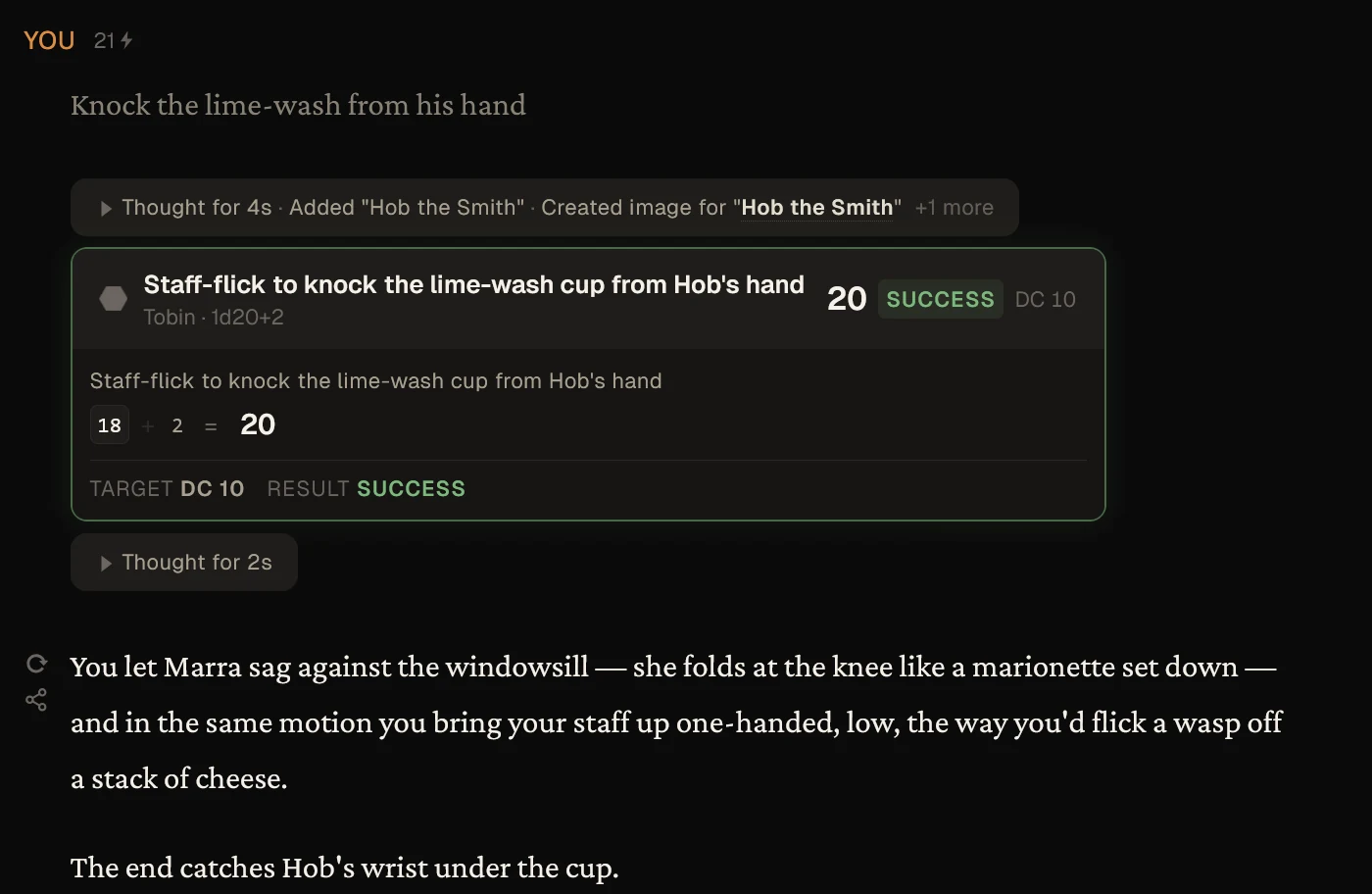
A turn from a real game: the roll and its math in the open, next to the GM visibly adding a new character to the tracked world.
FreedomRPG also doesn't ship a fixed system at all. The GM builds and enforces the rules of your world as you play. Start in Earthgarden and you get a designed system that can bend when your story needs it. Bring your own instead and the GM learns it: one creator fed it a full Rifts setting handbook and it ran the setting and the rules correctly. Homebrew, Pathfinder notes, your own magic system: the tracking adapts to the world rather than the world bending to fixed types.
Voice
FreedomRPG narrates aloud, inline, as you play. Everweave has no voice at all. One creator who switched described typing everything out and stitching voices together in word-chunks to produce narrated videos, versus FreedomRPG just reading the story to him.

The whole interface. It just reads to you.
What it costs
Everweave meters messages: 30 free per month, then $5.99 for 300, $17.99 for 1,000, or $54.99 for 3,000, with response speed improving as you pay more. Run out mid-scene and the story waits until next month or the next pack.
FreedomRPG has one credit currency. Credits meter what the game master actually does, you get free credits daily just for showing up, and there's no monthly message ceiling to run out of mid-scene. The honest caveat: heavy play costs real money, because frontier models cost real money. A typical action runs a few credits; you can see what any session cost you.
Side by side
| FreedomRPG | Everweave | |
|---|---|---|
| World memory | Maintained structured world: entities the GM reads and updates in play, ~300k context | Structured character sheet; the world lives in prose memory and fades |
| Cross-game memory | Yes, the GM remembers across your games | No |
| Character inner lives | Persistent private thoughts per character | No equivalent |
| Model | Claude on every tier, up to Claude Fable 5 | Undisclosed; speed sold as a paid feature |
| Rules | Built and enforced by the GM in real time, including your homebrew | 5e-shaped, model-enforced |
| Dice | Real rolls the GM abides by | Real rolls; adherence drifts per its own community |
| Voice narration | Built-in, inline | None |
| Presentation | Clean, text-first | Painted art, wizard, paper-doll, music: the stronger first impression |
| Mobile | Web only (works in mobile browsers) | Native iOS and Android apps |
| Pricing | One credit currency, daily free credits | 30 free messages/month, then $5.99-$54.99/month quotas |
| Community | Small | Large Discord, seasonal events |
Which one should you play?
Pick Everweave if you want a D&D-flavored game that looks and feels like one on your phone: quick sessions, a familiar 5e frame, seasonal events, and the best-looking first hour in the category. Its presentation is genuinely ahead of ours.
Pick FreedomRPG if you're the player who hits Everweave's wall: you want the world to stay true over months, your corrections to stick, your homebrew enforced, real dice, a voice that reads to you, and a game master that's the same quality whether or not you paid this month. Fair warning from one of the creators who tried it: FreedomRPG is narrative-driven and a lot of reading. Great for a particular kind of player, not for everyone. If you're that player, nothing else does what it does.
Try it
You get 300 credits when you sign up and free credits every day after, no card required. Begin your story
The community is small and early; if that sounds like your kind of thing, the Discord is where it lives, and joining earns you 500 credits.