Updates
August 19, 2026
Steadier Ground

The World Builder release was a big one, and this release is mostly the quieter work that follows it: bugfixes and stability across the game. The game master's storytelling has also been improved in a few ways, and the fallback model got an upgrade.
GM storytelling improvements
A lot of this release went into how the game master narrates and runs a scene. When you speak, it writes your line as you said it instead of paraphrasing you or skipping past it. It commits to what a roll means before it throws the dice, so the stakes can't shift once the result is in. Pressure the story has put you under holds instead of quietly fading while you do something else. Suggested actions no longer hint at things your character hasn't found yet.
A much better fallback game master
Claude sometimes refuses to continue a story. When that happens Freedom quietly hands the turn to Grok, so you keep playing instead of being stopped and told to try something else. That fallback has moved from Grok 4.5 to Grok 4.6, which is a considerably stronger storyteller, so the turns where it steps in now hold their own against the rest of your story.
Long campaigns cost less
A game that had been running a long time used to cost more per turn than a new one, and it got worse the longer you played. That no longer happens. A campaign you have been playing for months costs about what a fresh one does.
The game master can also go back and read any part of your story when it needs to. If it wants to check what someone said to you forty sessions ago, it can go and look rather than rely on remembering.
World Builder keeps up with you
You can keep typing while the World Builder is working. Anything you send during a turn waits its turn and shows up below the box, and you can take it back before it goes.
Other improvements
- The World Builder offers suggested next steps again at the end of a turn
- Worlds can no longer be published with characters missing their portraits
- Character portraits recover correctly if a game is reloaded while art is still generating
- Many smaller fixes and behind-the-scenes improvements across the game
August 7, 2026
Build Your World

This release touches nearly every part of Freedom, from creating a World to the way a story reads moment to moment. There is a new World Builder, an upgrade to Storyteller, richer dice, more legible changes to the World, better continuity in both narration and character art, and dozens of refinements across sharing and play.
World Builder
You now have a dedicated space to create the setting for your own stories. Start with an idea, a map, pages of notes, or anything in between, then build it with the game master through conversation.
As you talk, the World takes shape beside you. Its characters, places, factions, history, rules, relationships, art, and opening become a searchable encyclopedia you can explore as it grows. You can follow the connections across your World, keep adding detail, and rewind anything that takes it in the wrong direction.

When you're ready, play in the World yourself or share it so other people can start stories of their own. You can keep building afterward without changing stories already underway, then join the Freedom Discord and post the finished World in #share-your-worlds for the community to play.
Read the full guide to creating, playing, and sharing your own World.
Storyteller gets an upgrade
The Storyteller Game Master now runs on Claude Opus 5, at unchanged credit costs. Mythic got a buff in the same pass, and now puts more thought into every turn.
Stories keep moving when Claude refuses
If Claude refuses to continue a turn, Freedom now seamlessly switches the same GM to Grok 4.5 so your story can keep moving without retrying or changing the scene. Grok 4.5 stays with that game afterward, and those turns are charged for Grok 4.5 usage rather than the GM's usual backing model.
See what changed
When the game master changes something in the world, like a character trusting you more or a promise you made, you now get a one line note about it in the story. Things your character could not know stay hidden.
Dice that do what your system does
Rolls now understand rerolls, exploding dice, keep-highest and keep-lowest, success counting, failures that subtract or just get reported, and target numbers. Dice cards show how a result was reached, including where a roll was rerolled or transformed.
Characters as they were
A character's portrait now shows how they looked at that point in the story, rather than replacing every earlier appearance with their newest art. Stories you shared before this change are untouched.
Other improvements
- Game master replies now include what you said and did, so each turn reads as one complete scene
- You now know when the game master makes a secret roll, without revealing what it was for or how it went
- Story and moment sharing no longer get stuck after an interrupted turn, and sharing waits for the current turn to finish when needed
- Shared moments now use the scene you shared as their page image and link preview
- Rewind is now optional in Settings. Existing players keep it on, while new players can choose to enable it
- Read-aloud now retries brief interruptions and tells you when to try again
- The privacy policy has been rewritten to explain more clearly how Freedom handles your data
- Many smaller fixes and behind-the-scenes improvements across the game
July 22, 2026
Share Your World

Stories no longer have to stop with the player who started them. This release adds two ways to pass them on: share the World itself as a new starting point, or publish the story as an illustrated page for someone else to read.
Share a playable World
Open Share as World from a game to turn its characters, places, rules, history, and art into a stable starting point. Anyone with the link can begin a separate story in that World, while your own game carries on unchanged.
Read the guide to creating and sharing a World.
Share the whole story
Your Story can now publish a fixed version of the full illustrated transcript, including player messages, images, dice rolls, and visible game activity. The page is unlisted, and you can permanently revoke the link whenever you want. You can also select the share icon beside a game master response to share only that moment.
Read the guide to sharing your story, then join the Freedom Discord and share yours in Share Your Stories.
Password recovery
You can now reset a forgotten password by email. Accounts created with Google or Discord can also add a password, and changing one securely signs out existing sessions.
Other improvements
- Added an invite card to the lobby with your referral link and reward details
- Unfinished turns now preserve balances below 100 credits until you choose to continue anyway or buy more
- The lobby now shows the number of visible GM words in each story
- Roll-below checks now display their outcomes correctly
- Fixed read-aloud replay failing on some long messages
- Fixed the update banner repeatedly returning after a refresh
- Games recover more reliably after temporary connection problems and mobile screen lock
July 15, 2026
Bring Your Own Rulebook

This update is about bringing your own material into Freedom. You can now hand the GM your rulebooks, campaign notes, and images directly in chat, and it plays with what you gave it.
Bring your own rulebook
Attach images and PDFs to any message. Hand the GM a character sheet, a map, or a full rulebook and it reads them natively.
Big documents are handled sensibly: instead of swallowing a whole rulebook every turn, the GM keeps a library of everything you've uploaded and consults the pages it needs, when it needs them. A 200-page rulebook costs the pages consulted, not the whole book. Long pasted text works the same way.
There's a full guide on how to play any TTRPG system with an AI game master in the library.
Reference images
Uploaded images now guide portrait and scene generation. Give the GM a reference for your character and their portraits are drawn from it. Previously generated images feed back in too, so characters stay visually consistent across a session instead of drifting with every new image.
See how to use your own character art with an AI game master, starting from a hand-drawn sketch.
Watch the dice roll
Dice rolls now show a real d20 tumbling to your result instead of a static icon. Roll the maximum and the die lights up gold; roll the minimum and you'll feel that too.
A new lobby
The lobby now leads with art. World art fronts the Begin cards, your games show covers from their latest scenes, and release updates appear as a banner instead of a popup. New games also open on their world's establishing shot rather than a blank page.

Earthgarden grows
Earthgarden's lore has been expanded, fleshing out Eisenmark's identity and history and adding new characters to meet, including some born in a player's own campaign and canonized into the world (thanks, SamiBub). There are also rumors of an elusive dungeon somewhere in the plains of the Western Continent, for those inclined to go looking.
Other improvements
- Games created from a shared world now arrive with the world's images intact: the cover scene, character portraits, and any documents the creator uploaded all come along
- The GM now retries automatically after temporary errors instead of failing the turn
- Better text contrast in the dark theme
- More consistent character portraits
- Downloading your story is now a single "Download Story" button in the game header. The save-file export/import feature has been removed.
- Fixed read-aloud failing to replay on some messages
- Fixed garbled character codes occasionally appearing in the GM's text
- If an automatic credit top-up fails, you now get an email instead of a session stalling silently
- The pricing page now shows what credits buy in GM turns
- Many smaller bugfixes and quality-of-life improvements
July 7, 2026
Three Game Masters

This is the biggest Freedom update so far. It changes how you choose your GM, adds Claude Fable 5 as a new top-end option, adds a monthly membership that makes credits cheaper, and gives you better ways to share the moments that land.
To my knowledge, Freedom is the first hosted AI RPG to offer Claude Fable 5 directly. That matters because Mythic isn't only about nicer prose: it gives the GM more room to coordinate the world, the characters, and the shape of the story around what you do.
The headline is Mythic, but the real change is bigger than one tier: Freedom now has three Game Masters with clearer jobs.
Three Game Masters
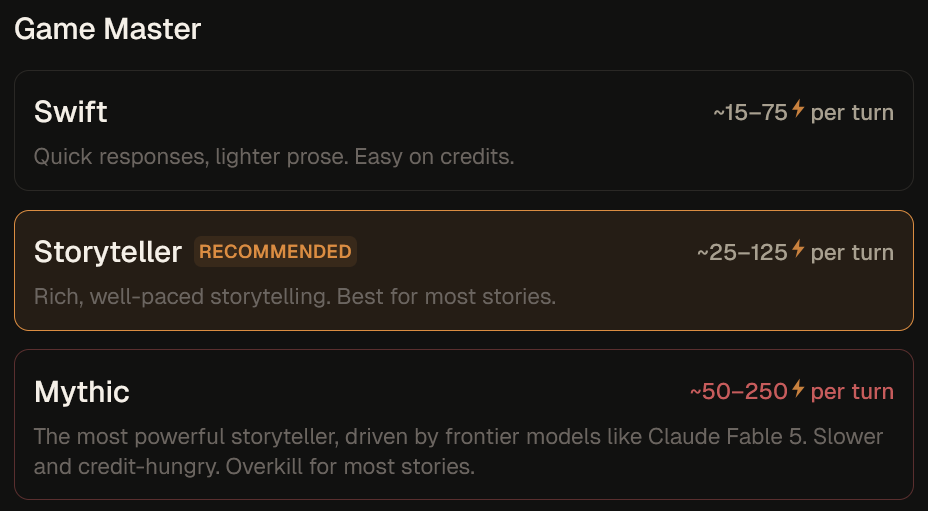
The old model and effort controls are gone. Instead, choose the kind of GM you want at the table.
Storyteller is the familiar Freedom GM. If you already liked the way Freedom played before this update, this is what you are used to: careful, prose-forward, and built for long-running games where the world remembers what happened.
Swift is the faster, cheaper GM. It keeps the same persistent world structure as Storyteller, but tends toward a more reactive, sandboxy style of play. It is a good fit when you want the world to respond quickly and keep moving.
Mythic is the new top tier. It is for games where you want the GM to do more than answer the next message: hold the world together, keep the narrative moving around your choices, and make fewer of the little consistency mistakes that can break trust in a campaign. It is slower and costs more credits, but it unlocks the richest version of Freedom.
Under the hood, these are all Claude models: Swift runs on Sonnet 5, Storyteller runs on Opus 4.8, and Mythic runs on Fable 5.
Credits and memberships
Freedom now has a monthly membership: $20/month for 2,667 credits. That is a 25% discount compared with normal credit top-ups, and the allowance is used first each month before your regular wallet credits.
The goal is simple: give regular players a cheaper source of credits, and make longer-running play feel a little less like watching every turn hit the meter. Freedom still uses credits because different scenes and different GMs cost different amounts to run, but membership makes the first 2,667 credits each month cheaper. If you use more than that, regular wallet credits and top-ups still work the same way.
Auto-reload covers the rest: if a session runs long, save a card and Freedom tops up your wallet automatically instead of stopping at the worst possible moment.
Share story moments
You can now share a moment from your game as a public page. If something makes you laugh, hurts in the right way, or just shows off what your world has become, you can pass that scene to someone else without explaining the whole campaign.
The shared page keeps the story styling, speaker blocks, and surrounding feel of the original scene, so it reads like a real excerpt from your world rather than a copied chat log.
Other improvements
- When the GM refuses a turn, you now have a way to retry instead of getting stuck
- If a turn is interrupted by running out of credits, Freedom can now resume it after a successful top-up or membership checkout
- The Stop button now stays available more reliably while the GM is working
- Earthgarden XP gain has been increased 2.5x for faster progression, and the world's lore has been updated to match
- Copying share links works more reliably in browsers with stricter clipboard rules
- Many smaller bugfixes and quality-of-life improvements
June 30, 2026
Email verification
Creating an account now requires a verified email address. No need to do anything if you already have an account; this only applies to new sign-ups.
Other improvements
- Fixed a bug where GM responses could appear duplicated on screen during streaming, until the page was refreshed
- Long error messages no longer overflow off-screen
June 27, 2026
Hand-crafted character portraits
Some characters now come with a portrait made just for them, shown the moment they appear instead of being generated on the spot. It loads instantly and doesn't cost you any credits. Earthgarden's demon lord is the first to get one, and more will appear as they are added.
More variety in "Surprise me"
"Surprise me" openings were settling into a similar shape too often. They now draw on a wider range of premises, so the situation you start in varies more from one roll to the next.
Other improvements
- Switching the AI model partway through a game now triggers a compaction to prevent large credit cost problems.
June 11, 2026
Scene images
The GM can now paint the scene, literally. When the story moves somewhere new, a wide establishing shot of the location appears right in the transcript. Returning to a place you've been brings its image back instead of generating a new one.
Image loading is more responsive across the board too: scenes and portraits update the moment they're ready, and you can hover a character's portrait in the chat to see it full size.
Better starts with "Surprise me"
"Surprise me" openings have been retuned. They start with higher stakes, lean less on worn tropes, and drop you in at the decisive moment rather than after it.
More natural dialogue
Characters speak more like people: less re-explaining things you already know, fewer speeches that wrap up neatly with the point spelled out. Narration has been tightened up too.
Other improvements
- GM refusals now show in the UI instead of the game silently retrying
- Error messages show their details up front instead of hiding them behind a click
- Claude Opus 4.6 and 4.7 have been retired from the model picker
- Fixed the "max" thinking effort setting appearing to hang
- Large pastes now collapse into a block on mobile, not just desktop
- Internal tool names no longer leak into the activity display
- A round of stability fixes for reconnects and long-running games
June 5, 2026
The GM can remember things across games now
The GM has a memory. It can write notes as it plays and search back through them later. Some of those notes belong to a single game; others are about you, and they carry from one game to the next.
Feedback is the main thing this changes. Tell the GM you want tougher fights, or that it keeps reaching for the same phrase, and it remembers past the end of the session. Start a new game and it still knows. Give it more to go on and it gets better at running games the way you like.
This applies to games you're already playing, not only new ones.
Other improvements
- The display that shows what the GM is doing as it works has had a visual cleanup
- Large pastes now turn into a collapsed block instead of flooding the message box
- The lobby and game views show a spinner while they load instead of sitting blank
- Mobile chat keeps its scroll position when you switch tabs
- Stray formatting tags no longer leak into character speech
- Character portraits refresh correctly when you reconnect
- Long games keep better track of how the story started instead of drifting over time
- Fixed several issues that could cause unpredictable credit usage
- Other GM and reliability fixes
May 31, 2026
No new features this time, just a round of fixes to smooth out some rough edges.
- Characters get their portraits more reliably. Every character gets a face as soon as they exist, even ones still off-screen, and the GM is more consistent about following through.
- Speaker portraits no longer get clipped at the edge of the chat on tablets.
- Creating and editing characters in New World games is smoother, with fewer GM hiccups.
- A handful of other GM and reliability fixes under the hood.
May 30, 2026
Now running on Claude Opus 4.8
Anthropic's latest model, Claude Opus 4.8, is now available in Freedom and is the default for new players. Most games will use it automatically. If you've already picked a model, you'll stay on it, and you can switch over to 4.8 any time from Settings.
Other improvements
- Characters still waiting on a portrait now show a clean monogram of their initial wherever they appear, instead of a generic placeholder image
- Portraits are less likely to briefly flash an older version while a new one is being generated
- Code snippets in these release notes now render correctly instead of showing escaped
<tags>
May 19, 2026
Dialogue is now visually anchored to the speaker
Character dialogue used to weave through prose as italic inline text. Now each speaker gets their own block with portrait and name, so you can see who's talking at a glance.
A more grounded GM
The GM has been retuned to keep more of the world behind the scenes. It used to spill most of what it knew into the narration; now there's more sitting in reserve, waiting for you to stumble onto it. Both new and existing games benefit.
Other improvements
- New users now default to the dark theme
- User-typed messages render as plain text, so stray
<tags>in prose no longer get parsed as markup - Personal referral codes are capped at 5 redemptions by default; message omegastick if you need a higher cap for an event or community
- Long games no longer fail their automatic context-saving step
- Characters get auto-generated portraits more reliably
- Download menu no longer pre-highlights the first item when opened with the mouse
- Various GM, infrastructure, and reliability improvements
April 30, 2026
Characters now have faces
The biggest thing in this release: every character in your game gets an auto-generated portrait. They show up on the dashboard and as a hover tooltip whenever a character's name appears in the story, so you can finally put a face to the names you've been adventuring with. If a portrait isn't quite right, you can ask the GM to regenerate it. This is on by default; you can turn it off in Settings if you'd rather imagine your characters yourself.
Export your story
There's a new download menu in-game that lets you export your story as a Markdown file. Useful for archiving a finished game, or just reading it back without all the UI chrome.
Pricing FAQ
Added a public /pricing page that explains how credits work, what the rates are, and how refunds are handled. Linked from the landing page.
Smoother compaction
Long-running games used to compact context mid-turn, which could feel like the GM stalling. Compaction now happens on session resume instead, so it's invisible during play. When you reopen a long game, you'll see a brief "Catching up with the story..." status before the GM's first response.
OOC messages no longer get lost
If you sent an out-of-character message while the GM was still typing, it used to get dropped. Now it queues and gets delivered as soon as the GM finishes.
Earthgarden updates
New rules for aimed-spell cover, absolute targeting, and homing nodes. Also compressed the lore and extracted spells into their own document, which should make GM context tighter and reduce the chance of the GM losing the thread on detailed lore.
Other improvements
- Multi-character games now get their own dashboard sections per character
- Image tool calls in the chat are labeled with the character name
- Lobby game cards are fully clickable, not just the title
- Fixed stale portraits showing on non-dashboard characters
- Fixed silent failure of the "What's New" modal
- Fixed empty progress bars rendering weirdly when the value went negative
- Various GM, sanitizer, and reliability improvements
April 19, 2026
A more proactive GM
The GM now drives the plot forward. You should feel less like you have to push the story forward yourself.
Earthgarden updates
Starting characters now get skills based on training, not level, so mages and scholars feel competent from the start. Also fixed a bug that made spell failure very punishing (read: deadly) at low levels.
Start a new Earthgarden game to try out the new rules.
Other improvements
- OAuth sign-in errors now surface as a toast instead of silently disappearing
- Fixed a bug where the GM could get stuck retrying after an OOC message
- TTS button now aligns with the retry button
- Various infrastructure and reliability improvements
April 16, 2026
New default model: Claude Opus 4.7
Freedom now uses Claude Opus 4.7 as the default Game Master. Pricing is the same as 4.6, and 4.6 is still available in Settings if you prefer it. Try it out and let me know what you think in the Discord.
Discord bonus credits
If you're in the Freedom Discord server, you can claim a one-time 500-credit bonus. Look for the new section in Settings. If you're not in the Discord yet, there's never been a better reason to join.
Other improvements
- Fixed a bug when enabling TTS mid-message
- Invite codes now tolerate leading and trailing whitespace when pasted
- Translation tooltip now works on mobile
- Various bugfixes and infrastructure improvements
April 14, 2026
Invite your friends
Freedom now has a referral system. Head to Settings and look for the "Invite Friends" section to grab your personal invite link. When a friend signs up with your link, they'll get 100 credits per day for 7 days, and you'll get a one-time reward of 500 credits. Share it with people you think would enjoy the app.
Dice rolls get their own UI
Dice rolls now appear as their own inline chip in the story, with a reveal animation when they resolve. The structure, hierarchy, and interaction have all been redesigned so rolls feel like a proper moment rather than a line of text you might scroll past.
Earthgarden updates
Continuing to flesh out Earthgarden. This update adds a Level-Up Ceremony, a proper economy system with updated equipment tiers and training costs, and a rewrite of the weapon rules and dying mechanics. Start a new Earthgarden game to try out the new rules.
Smarter GM for diverse settings
The GM's base prompt has been updated to handle a wider range of cultural settings with more nuance and care. You should notice more thoughtful representation when your game ventures beyond the usual fantasy defaults.
Other improvements
- Various bugfixes and minor improvements across the streaming narrative, character speech styling, and test reliability
April 9, 2026
Earthgarden
The GM now tracks your equipment and inventory on the dashboard, so you can see what you're carrying at a glance without asking.
I also doubled the XP yield (10% to 20%). This is the first of a few pacing tweaks I'm planning. The game has been feeling a little slow to progress, and I want to make it feel more rewarding to play.
Other improvements
- Fixed the TTS auto-play button showing the wrong icon
- Removed the compaction status notification. It was mostly noise.
- Added privacy-friendly page view analytics to the landing page (Plausible, no cookies, no personal data). Details in the privacy policy.
- Various bugfixes and infrastructure work
April 7, 2026
Sign in with Google or Discord
You can now log in with your Google or Discord account instead of using a magic link. Look for the new buttons on the sign-in page. You can also link and unlink accounts from settings.
Better dashboards
The dashboard now supports lists and information is presented in a (hopefully) more readable format. This means the GM can build more expressive character sheets, like showing skills as a proper list instead of repeating labels.
Other improvements
- Submitting a correction now shows a spinner right away instead of feeling unresponsive
- Fixed the privacy page being unreadable in light mode
- Removed the share excerpt feature. It was too bug-prone, but I still want people to be able to share parts of their story, so I will be working on a better solution for that in the future.
- Reworked some of the landing page copy
April 6, 2026
I've been hard at work improving the GM and adding new features.
Daily credits for everyone
Log in every day and you'll receive a small gift of credits. Have fun!
Narration replay
If you have TTS narration enabled, you can now replay any past GM message. Hover over a message and click the play button that appears below the retry button. Audio is cached locally so replaying the same message twice doesn't cost extra credits.
NPC agency
NPCs now have their own goals and motivations that drive their behavior between scenes. The GM tracks what NPCs are doing off-screen and weaves it into the narrative naturally.
Name variety
The GM is now much better at giving NPCs distinct names. Previously it had a tendency to reuse the same handful of names across different games (looking at you, Aldric Voss). Now it is more creative and generates a wider variety of names, so you won't have to endure the same cast of characters every time.
Other improvements
- Fixed action suggestions disappearing after a rollback
- Fixed TTS reading XML tags aloud instead of skipping them
- Thinking time now shows sub-second precision
- OOC and whisper flags are preserved when correcting a GM turn
- You can now queue actions while the GM is compacting history
- Various internal bugfixes and infrastructure improvements
April 4, 2026
Hi everyone 👋
This week I've been working on bringing the weaker parts of the Earthgarden world up to scratch. There are a lot of changes, so please start a new Earthgarden game to give them a try!
Earthgarden
- Fleshed out the magic system. The node-based spell construction was already there but pretty bare bones. Now there's a full node catalog with defined costs, strict pipeline grammar (Select→Shape→Filter→Effect→Modifier), per-school spell catalogs with starter spells, and graduated failure instead of a flat crit-fail mechanic.
- New level-based progression system. XP thresholds, stat points per level, stage transitions at milestones, plus talents every 5th/10th level and techniques earned through training and play. Replaces the old raw-XP-to-points approach that was hard to balance.
- More concrete combat timing. 5-second rounds, chant duration scales with spell complexity, and there are real tradeoffs for casting faster (higher difficulty).
- Fleshed out the hidden antagonist.
General
- Upgraded the default GM model to Claude Opus. Existing users on Sonnet have been migrated. You can still change models in settings.
- The GM now tracks a world clock, so time stays consistent scene-to-scene throughout long sessions.
- Thinking blocks now collapse into a tidy activity group instead of rendering inline. Each block shows its own duration so you can see how long the GM spent reasoning.
- New interface scale slider in settings replaces the old font size options. Goes from 87.5% to 150% and respects your browser's font size preferences.
- And a bunch of bugfixes and backend infrastructure improvements.